Tuesday, 12 July 2016

Good old buzz at Serangoon Road

Pictures taken 26 Jan 2016, a drizzly day.


Details on walls can be interesting. Here 
are a pair of racing horses decorating the 
wall of Haniffa Pte Ltd at 60, Serangoon Rd.
The company is more than 50 years old. Started
by one Mr O K Mohamed Haniffa at the shophouse
the business did more than OK. It grew and opened
 another branch at Dunlop Street. They have branches
in Malaysia and India.
Anyway, the Chinese always believe
 that horses are good fengshui!
.
For a dose of real "shophouse" buzz (if you are into that kind of buzz), nothing beats Serangoon Road.

You don't find any of the shophouses converted into some chi chi coffee houses, pubs or eateries. And some modern restaurants which started around the area with French food and etc, aren't all that pretentious. (Not sure whether the French Stall is still operating though, it was reported to be closing its doors in mid 2016 -- and I haven't tried its escargots!)

If you look at old pictures of Serangoon Road in National Library's PictureSG, you'll see that the shophouses now don't look too different from those in the 70s. The roads were just less crowded.

Which is great -- especially the wooden casement windows. 

Just a little trivial for you -- did you know that Joan Chen starred in a TV detective series called "Serangoon Road" -- set in the 60s? 


Sunday, 22 May 2016

Everton's preserved charms


Everton Road with its charming shophouses -- some are original and dating back to the late 1800s. Pictures: 7 May 2016.
Traditional wooden signboard on top of entance.
Auspicious couplets on doors.
Traditional outer swing doors. Windows (below) decorated with gold motifs.


66 Spottiswoode Park Road. An oft-photographed shophouse as its original 19th Century artwork got peeled off, uncovering the only known example of an intact and original 19th century decorative scheme in Singapore -- according to the URA website.
Back of shophouses facing Neil Road.

Wednesday, 30 March 2016

Purvis Street

Purvis Street, famous for its Hainanese eateries. Really must try Chin Chin Eating House one day. It has very good reviews. Just reading about its chicken rice, claypot mutton soup, Hainanese pork chop... makes me hungry. Only set back is that it's packed most of the time. And parking may be impossible. But yes, one day.
THE street was named after John Purvis -- born 1799, died 1872. He was a merchant in Singapore for some 50 years. He started John Purvis & Co in Singapore in 1822, was appointed a magistrate by Sir Stamford Raffles in 1823. He and his wife lived in Kampong Glam.

It is indeed an interesting street today. It even has a cat museum (live cats you can stroke during office hours, for a small fee which goes to the welfare of the cats which are mostly strays.). You can also find a few clan associations here (picture below). Thee main Hainanese clan association, the Kheng Chiu Hwee Kuan was established nearby in 1857, occupying three shophouses at Malabar Street which later moved to Beach Road, where it is today. 

BTW, Malabar Street is now an aircon street in Bugis Mall. But you can see how charmingly quaint it was in the old days: http://eresources.nlb.gov.sg/pictures/Details/488d1c93-b466-4a24-a134-2fba40cb5037 But of course, that's looking back with tinted lenses. Don't forget the squalor. 


Wednesday, 23 March 2016

Tan Quee Lan Street

Tan Quee Lan Street. I haven't tried any of the food there, but apparently, the street is much featured by netizens for its food. Anyway, the second part of World Street Food Congress Dialogue 2015 was held in an open field on this street, attracting more than 200 people from all over the world!  Pics taken Feb 2016

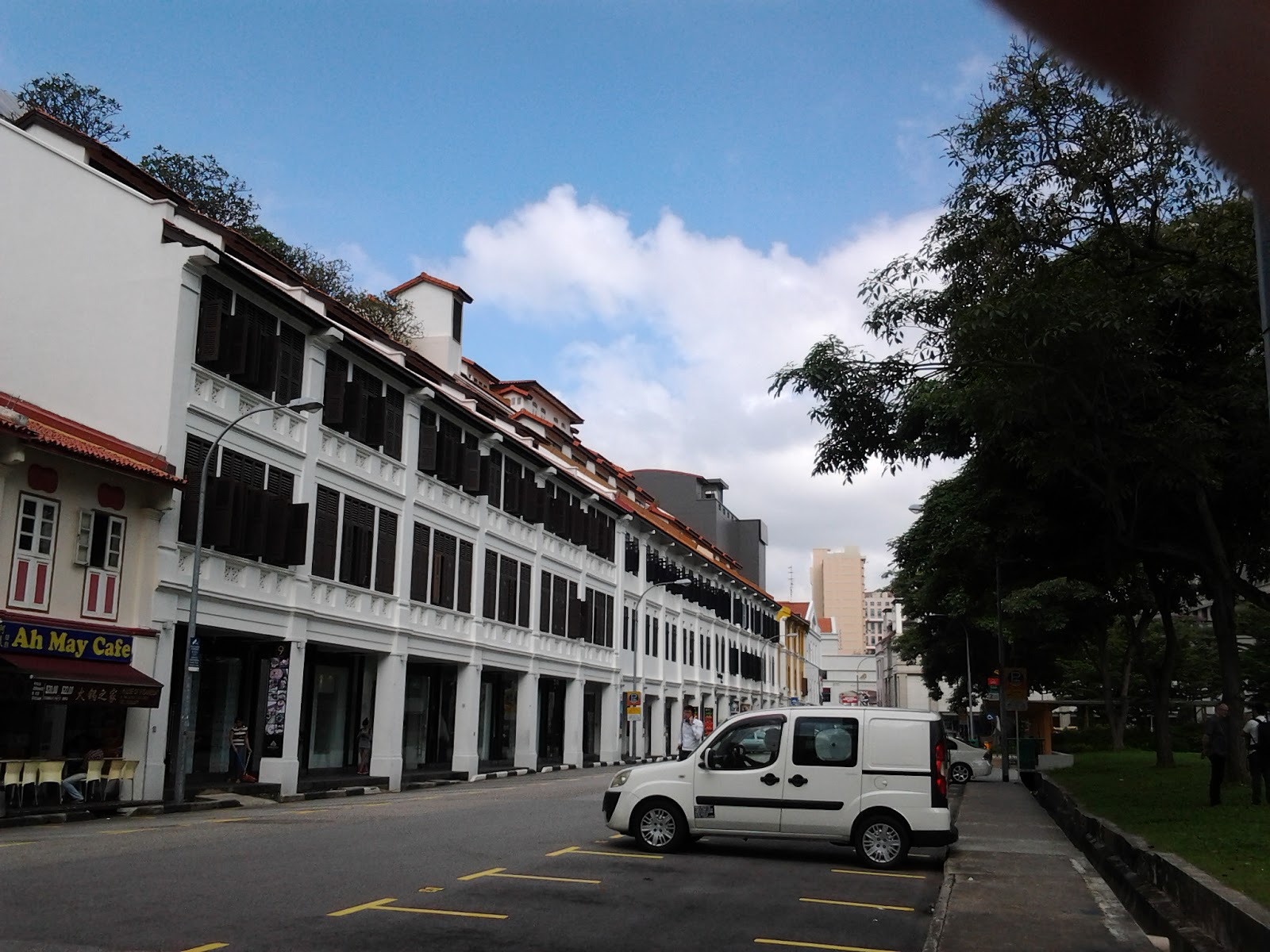
I thought this was a rather charming street, with quaint two-storey shophouses neatly juxtaposed with those three storeys high. Actually the refurbished ones (seem refurbished to me) are still quite quaint, with shrubs if not trees growing from their rooftops.

Of course, no traces today of its heydays when opium dens were rife and Chinese brothels (while the neighbouring streets such as Bugis Street housed the Japanese ones). According to the book, Rickshaw Coolie: A People's History of Singapore, 1880 -1940 by James Francis Warren, richshaw pullers were able to earn a few fast bucks from ferrying prostitutes around in this area, and running errands for them. The prostitutes, bedecked with gold jewelry and beautiful clothes, would take the rickshaw, even if it was from one block to the next.

The street was named after a rich Hokkien businessman (died 1904) who owned land at Club Street and elsewhere, including a part of Bukit Timah where his wife was buried. The mystery of an unknown grave at Bukit Brown behind some private houses along Sian Tuan Ave was unraveled by Asia Paranomal Investigators in 2011 and traced to Mrs Tan Quee Lan.

There was also a Quee Lan Hill where the Chinese Weekly Entertainment Club now sits (picture below).
The Chinese Weekly Entertainment Club sits on what used to be Quee Lan Hill.


Sunday, 22 November 2015

East Coast Road

A haven for food lovers, but a nightmare for parking. This is what this area means to me -- usually. So the smart thing to do is to take a bus.  In my younger days, the Red House Bakery (now under restoration, to the left of the picture) was a really interesting place to me.  You could choose your bread or whatever morsel and then have them in peace somewhere in the bowels of this bakery which looked small on the outside but had courtyards once you entered. Established in 1925 it was closed in 2003, deemed unsafe.  A Jew started the bakery shop which was later taken over by a Hainanese seaman who apparently paid only $600 as "coffee money" to take over the bakery.  That was in the 1930s.  Information taken from Infopedia.


Sunday, 6 September 2015

The "mirrors" of Syed Alwi Road

The row of shophouses at Syed Alwi Road towards Victoria Street (which runs more or less parallel to Jalan Besar). Syed Alwi Road is a rather long road.  The row at this stretch has decorative "mirror" motifs with windows as the reflective panel instead of mirrors. Similar designs (though not for windows) can be found in other shophouses in the area, like the one below along Jalan Besar. 


According to a write-up by the National Heritage Board, Syed Alwi Road was near a swampland (as late as 1924). Built in 1850s, it was originally named Jalan Bahru. Later, it was named after Justice of Peace Syed Alwi, son of Syed Ali who bought 70 acres of swampy land around the region, and noted for constructing wells at Selegie Road and even in Telok Ayer and Mohamed Ali Lane in Chinatown, to provide water for the public. Read about its history here: http://www.nhb.gov.sg/places/trails/jalan-besar/trail-sites/historic-sites/syed-alwi-road.

Mirror, mirror on the wall... Decorative motifs on a row of shophouses at corner of Kitchener Road where it meets Jalan Besar.


Sunday, 16 August 2015

The "ship bows" of Lorong Telok

A row of shophouses with the "ship bow" shape at Lorong Telok. Pictures taken 15 Aug 2015.

I haven't managed to find information on why this lane is called Lorong Telok. "Telok" in Malay means "bay" so perhaps it was so named because of its proximity to the historic Boat Quay along Singapore River.  According to PictureSG, the lane was once referred to by the Chinese as "bih lang koi" or bamboo rattan street because of the many basket making shops there. Today I couldn't find any traces of such shops, except for the signboard (above) of an association for rope hardware and paint merchants. But I guess this doesn't count :) The lane may be rather short, but it is packed with pubs and eateries that are featured in a few food blogs -- which makes the place a little too touristy for my liking.  What's interesting (to me) is that Lor Telok has two "ship bows" (top picture and below).

The "ship bow" at the junction of Lor Telok and Circular Road.

Low rise two-storey shophouses interspersed with taller ones at Lor Telok. 

A closed and shuttered unit awaiting a tenant or renovation along Lor Telok. It has old fashioned folding doors that would make those familiar "crack-crack-crack" sounds in the morning when shops open for business -- as quite a few of us can remember.